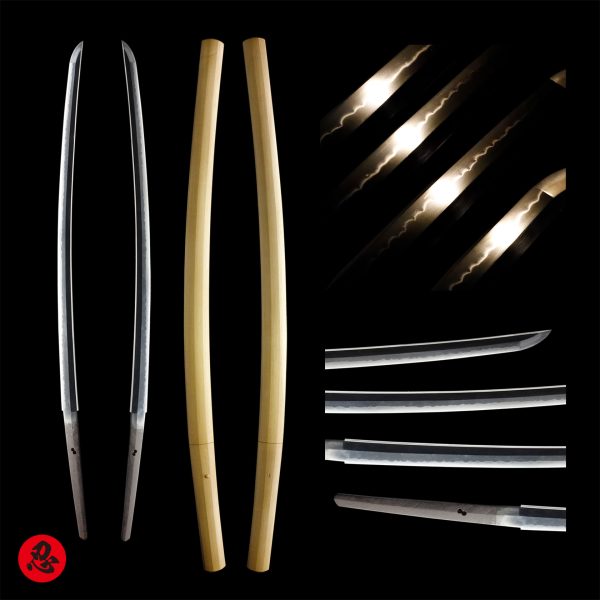



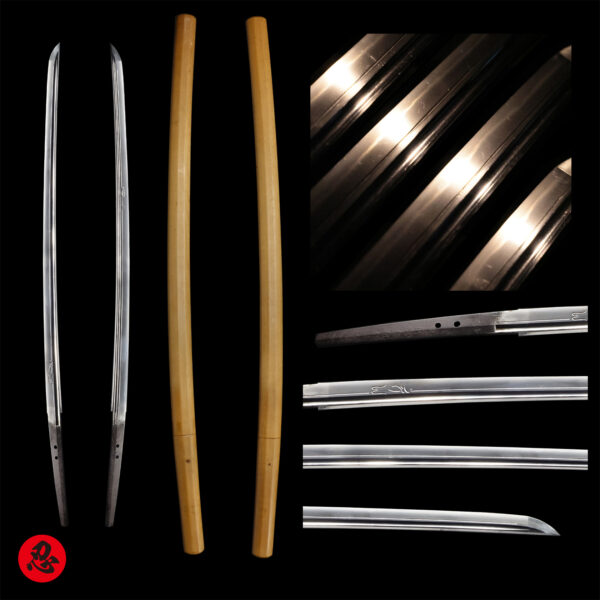
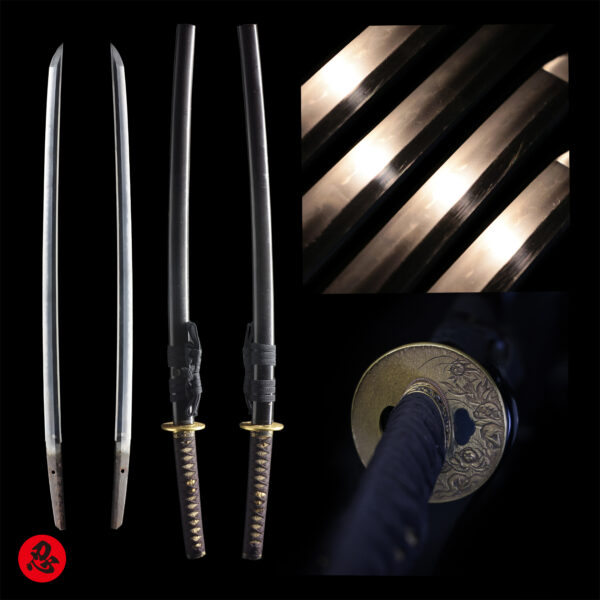

Antique Japanese Sword Daisho Katana Signed by Hiroshige with Kichou Certificate, Wakizashi Signed by Kunisuke Signature No Certificate (#Toyama 2440-2441)
【Description】
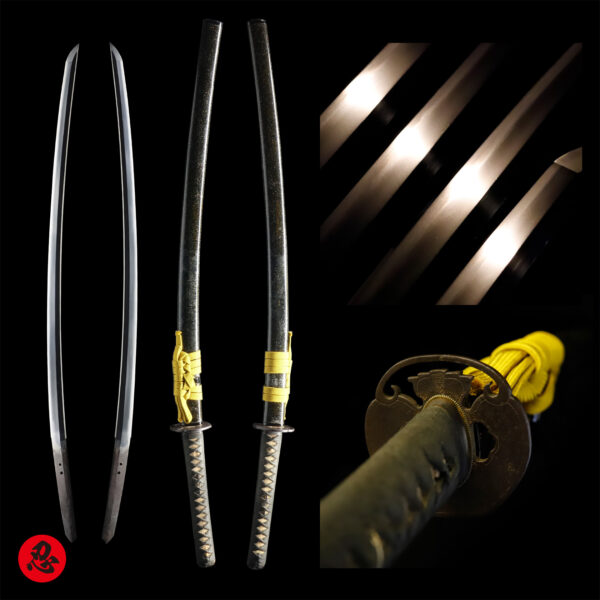
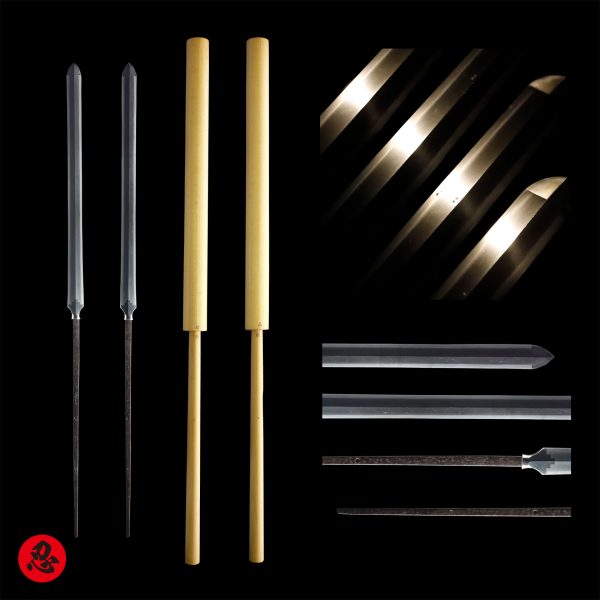
This piece is a matched Daisho set consisting of a katana and a wakizashi.
The katana was signed Sagami no Kami Fujiwara Hiroshige and has been appraised by the Nihon Bijutsu Touken Hozon Kyokai (NBTHK) as Kichou Touken, an older form of certification issued under the former appraisal system.
Hiroshige was a swordsmith of the Shitahara school (下原派) of Musashi Province. The school traces its origins to Yamamoto Chikashige, who lived in what is now Hachioji, Tokyo, around the Eisho era (early 16th century). From this founder, the Yamamoto family expanded into approximately ten related lineages, and the school flourished through the late Edo period.
Within this tradition, the court title “Sagami no Kami” was adopted only from the third generation Hiroshige onward, beginning in the Azuchi–Momoyama period. Blades bearing this provincial title therefore represent a later and more established phase of the Hiroshige lineage.
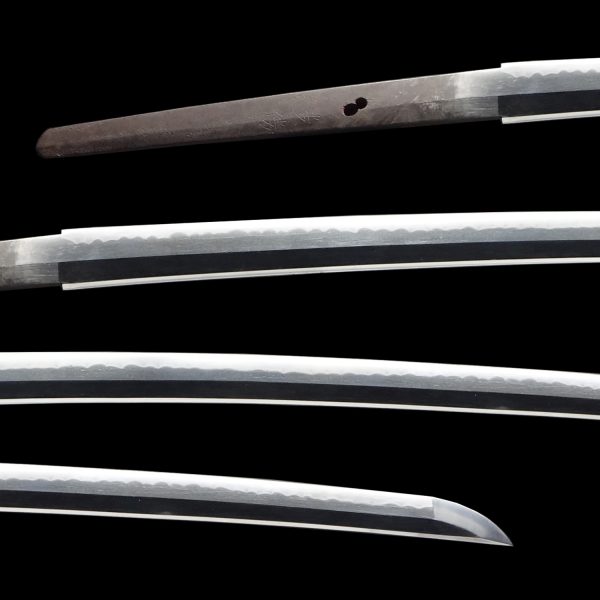
The wakizashi was signed Fujiwara Kunisuke; howeve, please keep in mind that that there is NO GUARANTEE of its signature’s authenticity because it doesn’t come with any certificates.. Nevertheless, official registration papers have been issued, as with the Wakizashi. This indicates that the Agency for Cultural Affairs (Bunkacho) recognizes the sword as a work of art. To be registered, a sword must be traditionally hand-forged using tamahagane carbon steel. Both blades display a beautiful hamon (tempering line), complemented by elegant koshirae (sword mountings).
-Katana
This type of Japanese sword is categorized as Katana. Katana (UCHI-GATANA) was designed to stab or thrush opponents during the MUROMACHI period and was being widely used until the Edo period (1333-1868 A.D.).
Katana is relatively shorter than TACHI and worn on the left waist with its blade up so that Samurai could draw it with one move as soon as possible. The curvature or length of those Katanas depends on the periods and one’s preferences.
It was usually used in ground-fighting, whereas TACHI was utilized on horseback. Samurai would also use Katana to fight over challenges from others, or apply their martial forces against crimes or anti-governmental activities in public. And a high-quality Katana was often given by a feudal lord to his subordinate as a gift for having achieved great success at war. It is the most famous type of Japanese sword as well.
-Wakizashi
WAKIZASHI refers to a 30-60 cm long blade (11.8-28.6 inches) and was worn on the waist along with UCHI-GATANA (Katana). Samurai carried WAKIZASHI as a backup sword next to Katana. Samurai needed to use Wakizashi when he fought in a small room or with proximity where Katana would be too long to unsheathe. Also, when Samurai entered a castle, he had to leave his Katana to the castle guard. In contrast, Wakizashi was allowed to bring inside as self-protection.
WAKIZASHI was also the sword for the famous Samurai custom called SEPPUKU (切腹; Stomach-Cut), the ritual act of Samurai to take responsibility for crime act or losing battles.
The use of Wakizashi became more widespread among Samurais during the Edo period (1603-1868 A.D.). Because the Edo Government had launched the national law to force all Samurais to wear two Japanese swords (Katana and Wakizashi) to identify themselves as the regime’s military officers.
What is Daisho?
Daisho is a pair of two Japanese swords Samurai carried. During the Edo period, having Daisho in public places was considered social status for Samurai. Furthermore, Samurai were required to wear them under the law back then. Daisho is written as 大=Big and 小=Small. Dai part means Katana, and Sho part means Wakizashi.
What is the material of Japanese sword?
Japanese blacksmithing has over a millennium of history. It dates back to the 1st century A.D. when ancient blacksmiths studied template method from the continent. Copper pottery and rice farming techniques were also introduced to Japan at the same time.
Since then, Japanese blacksmiths had spent centuries to invent the traditional metal forging technique called TATARA(鑪). TATARA is a clay melting pot where you put iron sand and charcoal together to bond these chemicals with intensive heat. By using this technique, they started to make Japanese swords out of Tatara carbon-steel. This type of carbon-steel was later called TAMA-HAGANE (玉鋼; Ball-Steel).
*Please keep in mind that there is no certificate for this wakizashi.
*Please keep in mind that both blades have light black rust and Kitae Kizu.
【 Blade】
-Katana
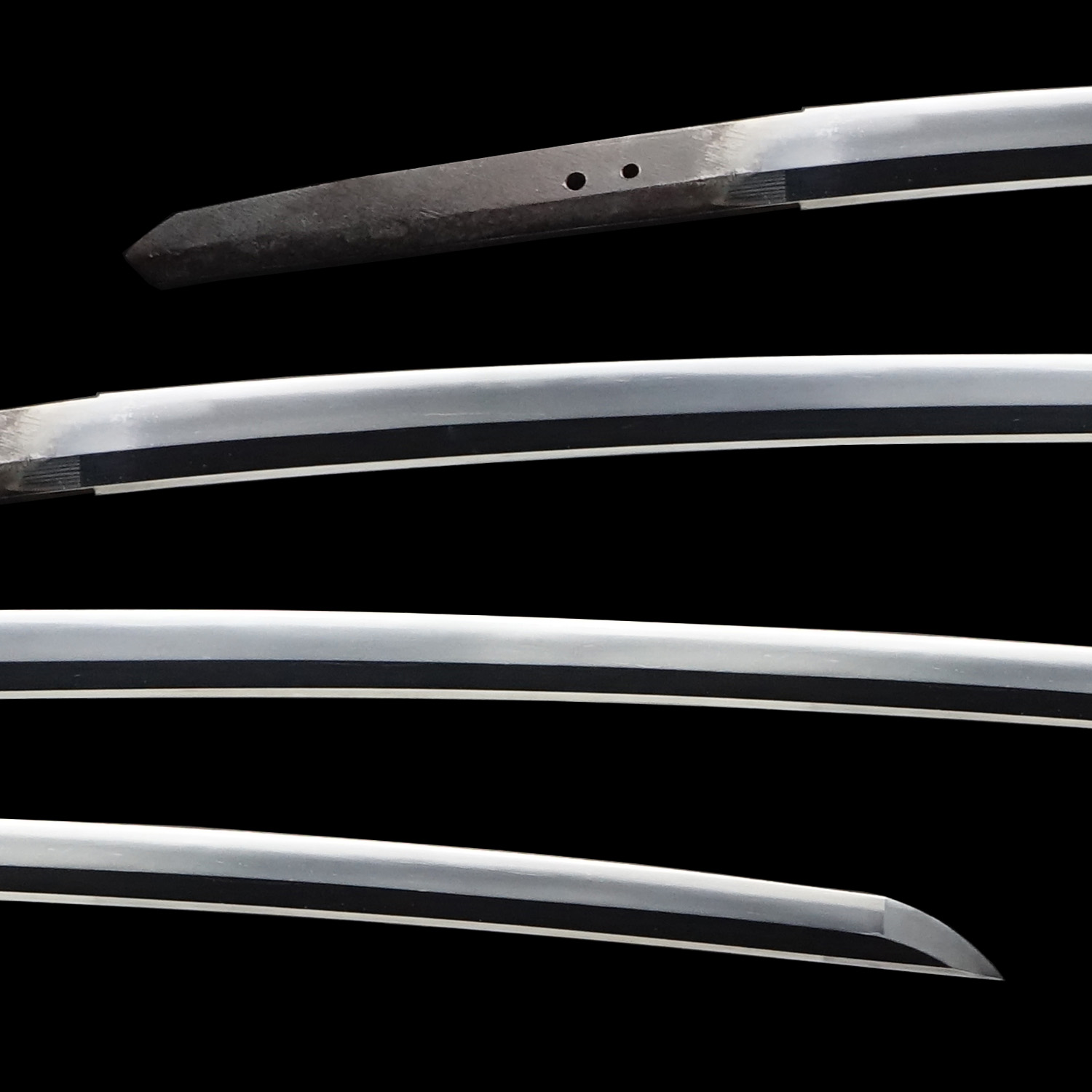
Cutting Edge Length(Nagasa):74.2 cm (25.8 inches)
Curvature(Sori):1.8 cm (0.7 inches)


-Wakizashi
Cutting Edge Length(Nagasa):53.6 cm (21.1 inches)
Curvature(Sori):1.2 cm (0.47 inches)


Hamon:
The crystalline structure which forms along the cutting edge of a blade as a result of the hardening process
Jimon(Jihada):
visible steel surface pattern created by folding and hammering during forging process
-Katana


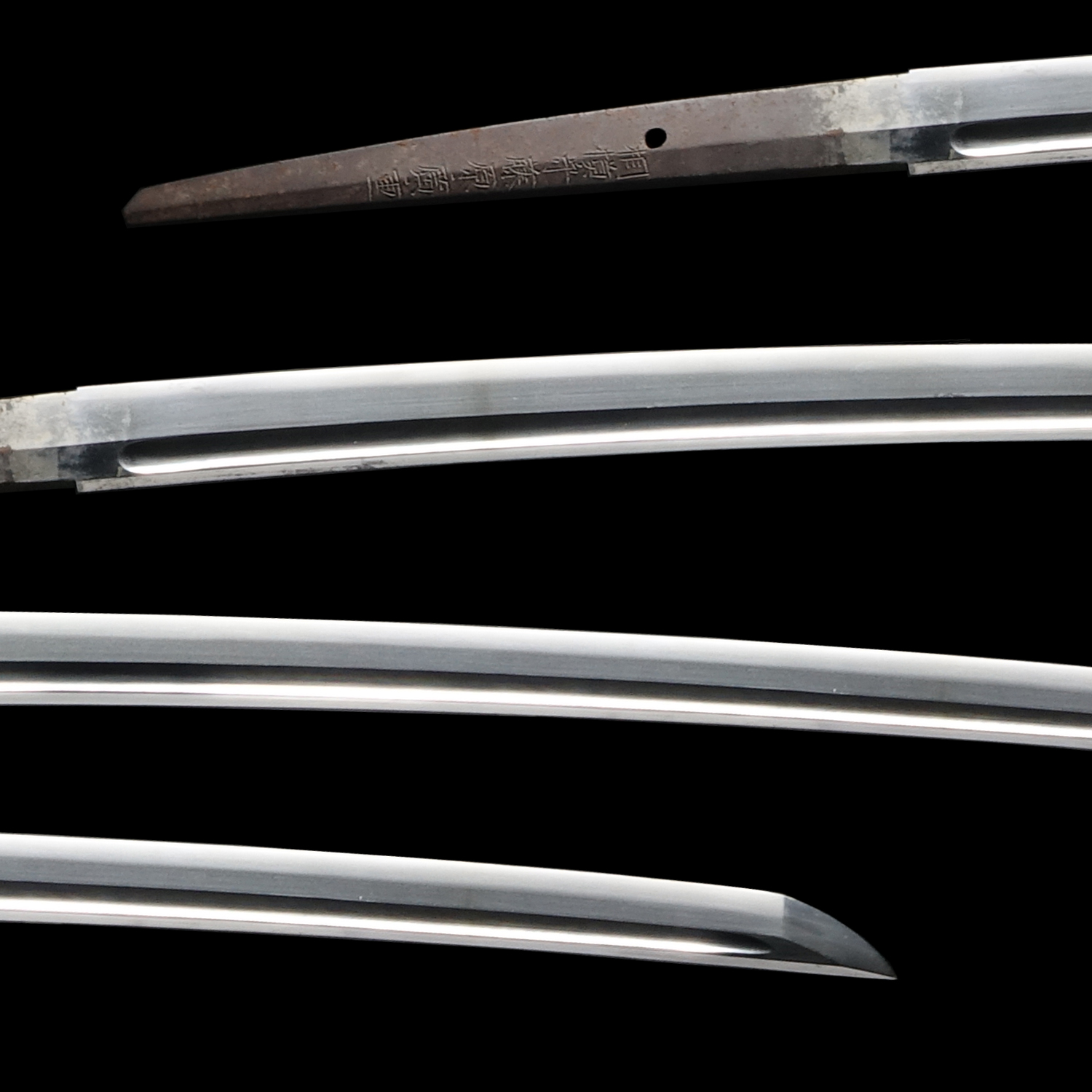
-Wakizashi


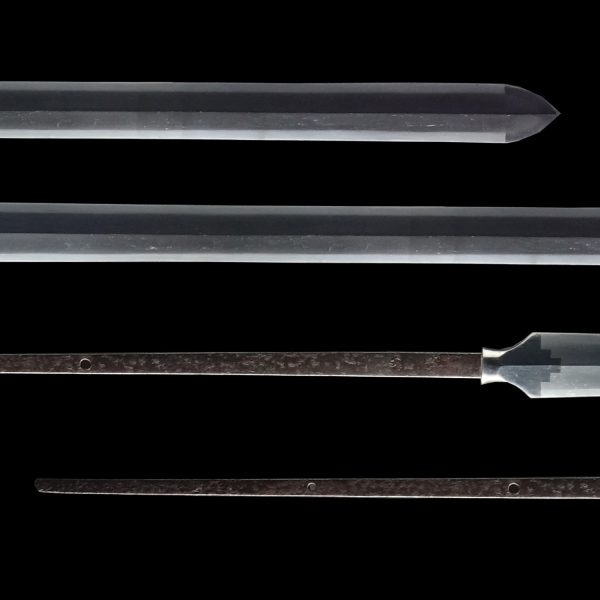
Nakago:Nakago is the tang of the Japanese sword.
Japanese swordsmiths left the black rust on the tang because it prevents red rust while the tang is in its handle. And the discoloration of the tang was created over time, and it is a great indicator for a Japanese sword specialist to estimate when the sword was forged.


Koshirae:Koshirae is the mounting of the Japanese sword. There are several parts that consist of Koshirae such as Saya (Scabbard), Tsuka (Handle), Tsuba (Handguard).

Authentication Paper:NBTHK KICHOU Certificate for the Katana blade (No. 14731)
NBTHK, also known as Nihon Bijutsu Touken Hozon Kyokai (the Society for the Preservation of the Japan Art Sword), is one of the oldest Japanese sword appraising organizations in modern-day Japan. They authenticated the blade on May 26th in the 30th year of Showa (1955). They appraised it as Kichou Touken, an old form of the certificate. The purchaser will receive this original certificate as well. We can also translate what is written into English and make a PDF file for your record if you request.

Registration Number : Toyama 2440-2441
The Board of Education in Toyama prefecture issued a registration paper for this sword. It is called Jyu Token Rui Torokusho (銃刀剣類登録証). Bunkacho (The Agency for Cultural Affairs) acknowledges a Japanese sword with this paper as a work of art.
The sword needs to be traditionally hand-forged and made of Tamahagane carbon steel to be registered in the system. With this paper, its owner in Japan can legally own an authentic Japanese sword. Based on this registration number, we will apply for its export permit.
This paper will need to be returned to the board of education when the sword is being shipped abroad, but you can receive a copy of it. An English translation of this registration paper is available on request.


—————————————————————–
【About us】
Ninja Weapon Museum is located in Kanazawa, Japan, exhibiting antique artifacts related to the history of Ninja and Samurai.
【Japanese Sword& Export Process】
The Japanese swords we deal with are hand-forged edged swords made in Japan. It was made from the traditional carbon steel called TAMAHAGANE(玉鋼). Samurai Museum is familiar with the proper legal procedure for an antique/ authentic Japanese sword to be exported from Japan.
Each Japanese sword is registered under the Agency for Cultural Affairs and the Board of Education in Japan. They issue a registration paper for each Japanese sword for its owner in Japan to legally possess it. The Japanese sword with its registration paper means it was traditionally hand-forged in Japan.
To legally export the sword from Japan to other countries, we will have to apply for its permit to the Agency for Cultural Affairs(Bunkacho) and return the original registration paper to the Board of Education. It normally takes around 2-4 weeks to receive this permit after submitting required documents. And we would like you to expect at least 1-1.5 months for your order to arrive at your given address after you ordered.
【Payment method】
We accept payment through Stripe(Credit card), Apple Pay, or ChromePay, all of which are secure payment methods. If you prefer other payment methods, please contact us. You may either pay in JPY, USD. The price is set in Japanese Yen. Prices in other currencies are automatically calculated based on the latest exchange rate.
*If you like to use PayPal, please feel free to contact us

【Shipping】
We have shipped authentic Japanese swords to the USA, Canada, Mexico, Germany, France, Hong Kong and Australia. If you don’t live in these countries and like to order, please contact us first before making a purchase. We offer Free International Shipping as long as we can send antique Japanese swords by EMS.
We normally ship by EMS(Express Mail Service) provided by Japan Post.
We will send you a tracking number for your order as soon as we hand it to the post office. We will put 100 % insurance on the shipping document without any extra charge. Based on the total amount, there might be a duty tax or other fee for you to pay, depending on the countries. We use package cushioning to protect the item and put it in a PVC pipe, which is one of the most secure packages because of its durability.
It will normally takes 5-14 days for the item to arrive at your given address after we dispatch it. Time of delivery is estimated as accurately as possible by the carrier but does not take into account any delays beyond our control such as by inclement weather, post office holiday seasons.
* If you live in Australia and like to purchase an authentic Japanese sword, please click here to know the detail.

【How To Contact Us】
Please contact us through email, Facebook Messenger if you have any questions. You can find each icon on the right side of the website. Please click one of them to reach us. We will reply to you within 1-2 business days.
【A Guide to Japanese Sword Maintenance】
After acquiring an genuine Japanese sword, it is also important to know how to take good care of it. Here is the special video for you. Mr. Paul Martin, Japanese sword expert, shows you how to give proper maintenance to your sword. By mastering how to clean the Japanese sword, its aesthetic beauty will last forever.
*This video is uploaded in Samurai Museum Shop, which is run by Tonbo8 CO,LTD, the same company as Ninja Weapon Museum Shop.
MORE ANTIQUE JAPANESE SWORD FOR SALE
Thank you for reading all the information on the page. If you have any difficulty choosing the right Japanese sword for you, we will be more than happy to help you find the one that speaks to you the most. Please feel free to contact us.